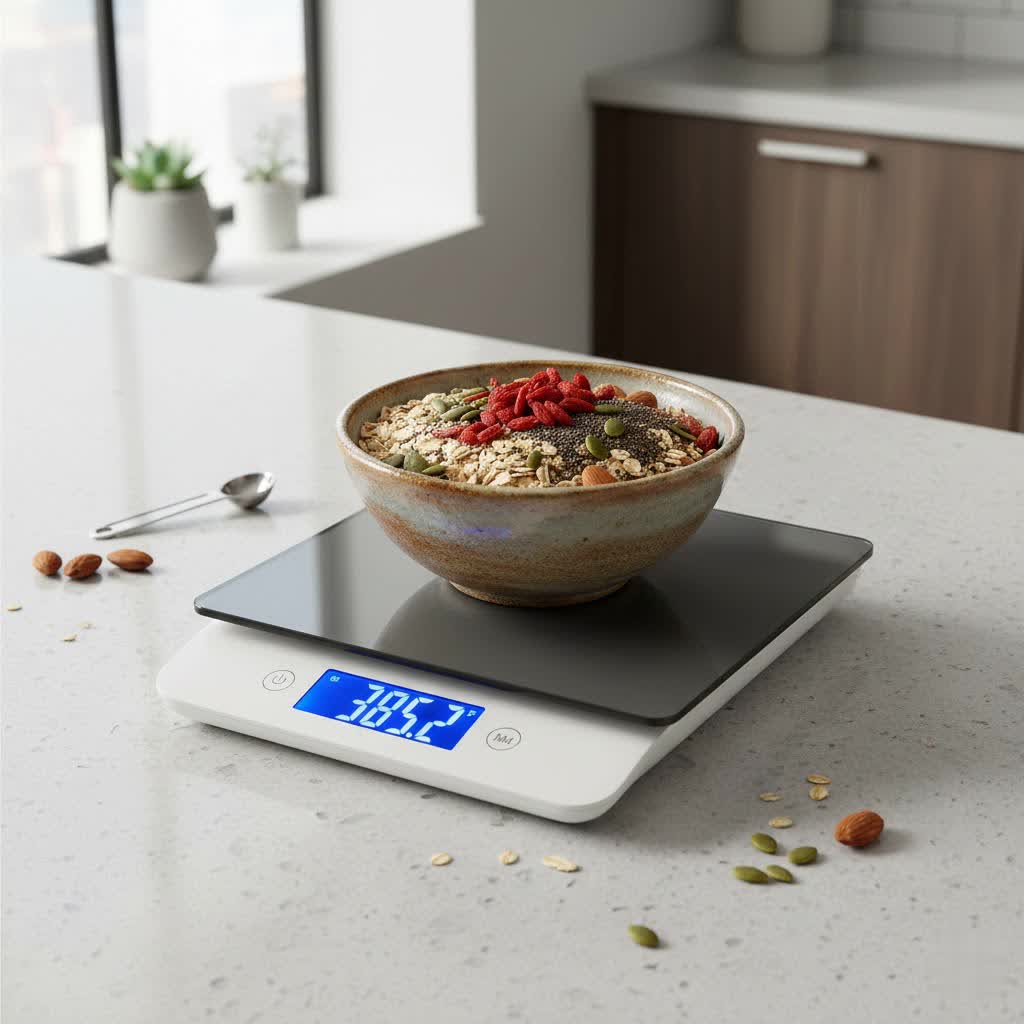
Every seasoned home cook and baker understands the critical role precision plays in the kitchen. Just a few grams off in a delicate recipe can mean the difference between a culinary triumph and a frustrating flop. Your digital kitchen scale is your trusted partner in achieving that precision, but like any essential tool, its accuracy can drift over time. Knowing how to quickly and reliably check if your scale is still giving you true readings is a game-changer. This guide will walk you through simple, effective methods to verify your kitchen scale’s accuracy, ensuring your culinary creations are consistently perfect.
Why Kitchen Scale Accuracy Matters for Every Home Cook
The importance of an accurate kitchen scale extends far beyond just professional chefs or meticulous bakers. For anyone who enjoys cooking, baking, or managing their dietary intake, precision is key. In baking, exact measurements of flour, sugar, and leavening agents directly impact texture, rise, and flavor. A slightly off measurement can lead to dense cakes, crumbly cookies, or breads that don’t rise properly.
Beyond baking, accurate weighing is crucial for portion control, especially for those following specific dietary plans or monitoring nutrient intake. An inaccurate scale can undermine your efforts, making it harder to reach your health goals. Moreover, precise measurements prevent waste by ensuring ingredients are used in the correct proportions, saving both food and money. In essence, a well-calibrated scale ensures consistency, reliability, and ultimately, greater satisfaction in all your kitchen endeavors.
Signs Your Kitchen Scale Might Be Losing Its Precision
Even the best digital kitchen scales can eventually lose their accuracy. Recognizing the signs early can prevent many kitchen woes. One of the most common indicators is inconsistent readings. If you weigh the same item multiple times in quick succession and get different results, your scale might be acting up. Another tell-tale sign is when the scale fails to return to a perfect zero after removing an item, or it displays a negative weight.
Have you noticed your favorite recipes suddenly aren’t turning out right, despite following them precisely? This could be a subtle hint that your scale is off. Over time, the internal components can wear down, batteries can weaken, or minor physical shocks can affect the sensitive load cells. If your scale is old, has been dropped, or simply isn’t performing as reliably as it used to, it’s definitely time for an accuracy check.
Essential Tests: How to Verify Your Scale’s Accuracy
Before you start blaming your baking skills or your recipe, let’s verify if your kitchen scale is still a trustworthy companion. You don’t need fancy equipment; everyday household items can serve as surprisingly accurate calibration tools.
The Coin Test: Your Pocket-Sized Calibration Tool
|
Our Picks for the Best Digital kitchen scale in 2026
As an Amazon Associate I earn from qualifying purchases.
|
||
| Num | Product | Action |
|---|---|---|
| 1 | Ultrean Food Scale, Digital Kitchen Scale with LCD Display, Weight Grams and Ounces for Baking Cooking and Meal Prep, 6 Units with Tare Function, 304 Stainless Steel, 11lb (Batteries Included) |

|
| 2 | OXO Good Grips 11-Pound Stainless Steel Kitchen Scale with Pull-Out Display - Black |
|
| 3 | Mik-Nana Food Scale, 22lb Digital Kitchen Scale with 6 Units Tare Function & LCD Display, Stainless Steel Weight Grams and Ounces for Baking, Cooking and Meal Prep (Batteries Included) |
|
| 4 | Mik-Nana Food Scale, 10kg/22lb Digital Kitchen Scale Weight Grams and Ounces for Baking Cooking Coffee Package Postage, 6 Units with Tare Function, LCD Display, Easy Clean Stainless Steel |
|
| 5 | Etekcity Food Kitchen Scale, Digital Grams and Ounces for Weight Loss, Baking, Cooking, Keto and Meal Prep, LCD Display, Medium, 304 Stainless Steel |
|
| 6 | Food Scale, 11lb Kitchen Scale with 0.05oz/1g Precision, 6 Units Tare Function & LCD Display, Stainless Steel Digital Scale for Baking, Cooking, Meal Prep - Kitchen Gadgets & Gifts, Home Essentials |
|
| 7 | Nicewell Food Scale, 22lb Digital Kitchen Scale Weight Grams and oz for Cooking Baking, 1g/0.1oz Precise Graduation, Stainless Steel and Tempered Glass |
|
| 8 | Amazon Basics Digital Kitchen Scale with LCD Display, Tare Function, Multiple Units, Weighs up to 11 Pounds, Batteries Included, Black and Stainless Steel |
|
| 9 | Etekcity Digital Food Kitchen Scale, Grams and Oz for Weight Loss, Baking and Cooking, 0.05oz/1g Precise Graduation,5 Weight Units, IPX6 Waterproof, USB Rechargeable,304 Stainless Steel-Silver, 22lb |
|
| 10 | Food Scale -33lb Digital Kitchen Scale for Food Ounces Grams Rechargeable 304 Stainless Steel,Batteries and Type-C Charging | Perfect for Meal Prep, Cooking, and Baking, Black |
|
The coin test is one of the simplest and most accessible ways to check your scale’s accuracy. Many common coins have a standardized weight, making them excellent test subjects.
Using U.S. Nickels (5g each):
U.S. nickels are renowned for their consistent weight of exactly 5 grams (approximately 0.176 ounces). This makes them ideal for checking smaller increments on your scale.
- Prepare your scale: Place your kitchen scale on a flat, stable surface. Turn it on and ensure it reads zero. If it doesn’t, use the tare function to zero it out.
- Weigh a single nickel: Carefully place one U.S. nickel in the center of the scale. It should read 5 grams.
- Check linearity with multiple nickels: Add a second nickel. The scale should now read 10 grams. Add a third for 15 grams, and so on. This helps assess if your scale is accurate across a range of weights.
If your scale consistently shows the correct weight for one, two, or three nickels, its precision for small measurements is likely intact. If the readings are off, try another set of nickels to rule out any anomalies with a particular coin.
Alternative: Pennies (2.5g each):
While nickels are preferred for their rounder weight, U.S. pennies weigh approximately 2.5 grams. You can use them similarly, expecting 2.5g for one, 5g for two, and 7.5g for three.
The Water Test: Simple and Effective
Water provides a wonderfully straightforward way to test your scale, especially for larger weights, thanks to a simple principle: 1 milliliter (ml) of water weighs approximately 1 gram (g).
- Gather your tools: You’ll need your kitchen scale, a clean, dry measuring cup with clear milliliter markings, and water. A measuring cup with a spout is helpful for pouring.
- Tare your container: Place the empty measuring cup on your scale. Turn the scale on or use the tare function to zero out the weight of the cup. This ensures you’re only measuring the water.
- Measure the water: Carefully pour a precise amount of water into the measuring cup, for example, 100 ml.
- Verify the weight: Place the measuring cup with 100 ml of water back on the tared scale. It should read very close to 100 grams.
- Test different volumes: Repeat the process with 200 ml, 500 ml, or even 1000 ml (1 liter), expecting corresponding weights of 200g, 500g, and 1000g.
This method helps you check accuracy at different weight capacities and is especially useful if you frequently measure liquids for recipes.
Pre-Packaged Items Test: Everyday Verification
Many everyday grocery items come with precisely labeled weights. These can be convenient, ready-made test weights for your scale.
- A new stick of butter: In the U.S., a standard stick of butter typically weighs 113 grams (or 4 ounces). Place an unopened, fresh stick of butter on your scale. If it reads 113g (or 4oz), your scale is likely accurate for that weight range.
- Small bags of sugar or flour: If you have a brand-new, unopened bag of sugar or flour (e.g., a 1kg bag), you can place it on the scale to verify. Note that packaging variations can sometimes lead to slight discrepancies, but it should be very close to the labeled weight.
- Canned goods: Many cans list their net weight. However, be aware that net weight often refers to the contents, and the can itself adds extra weight. This method is generally less precise than butter or coins.
When using pre-packaged items, always use unopened packages to ensure the contents haven’t been altered.
Calibration Weights: For the Utmost Precision (If Available)
For those who demand the highest level of accuracy, or if you frequently use your scale for very precise tasks, dedicated calibration weights are the gold standard. These are precisely manufactured weights, often in sets (e.g., 50g, 100g, 200g), specifically designed for calibrating and testing scales.
If you own a set of calibration weights:
- Place on scale: Follow the same initial steps as with coins: place the scale on a flat surface, turn it on, and zero it out.
- Weigh sequentially: Place one calibration weight (e.g., 100g) on the scale and verify the reading. Add another (e.g., a 50g weight for a total of 150g) and check the sum.
- Consult manual: Your scale’s manual may even specify the exact type and weight of calibration weights to use for a full calibration procedure, if your scale supports user calibration.
While not essential for every home cook, using calibration weights offers the most definitive check of your scale’s performance.
What to Do If Your Kitchen Scale is Inaccurate
If your kitchen scale fails the accuracy tests, don’t despair! Several troubleshooting steps and potential solutions are available before you consider buying a new one.
Troubleshooting Common Issues
Often, inaccuracies are due to simple, fixable problems:
- Check Battery: Low batteries are a frequent culprit for erratic or inconsistent readings. Replace the batteries with fresh ones and re-test.
- Ensure a Flat, Stable Surface: Scales are sensitive. Any unevenness on your countertop or wobbly legs can throw off readings. Always use your scale on a perfectly flat, hard, and stable surface.
- Clean the Scale: Food debris, spills, or dust can get trapped under the weighing platform or in crevices, interfering with the sensors. Gently wipe down your scale with a damp cloth. Avoid submerging it in water.
- Avoid Overloading: Each scale has a maximum weight capacity. Exceeding this limit can damage the internal sensors and lead to permanent inaccuracies. Always stay within your scale’s specified range.
Recalibration: Restoring Your Scale’s Precision
Many digital kitchen scales offer a recalibration function, allowing you to reset their internal sensors for optimal accuracy.
- Refer to Manufacturer’s Manual: This is the most crucial step. Each scale model can have a unique recalibration process. Your manual will outline the specific buttons to press, the sequence, and often, the exact weight (a calibration weight) required to complete the process.
- General Steps for Digital Scales: Some scales might involve holding down a “CAL” or “MODE” button, placing a specific weight, and waiting for the display to confirm calibration. Never attempt to recalibrate without consulting your manual, as an incorrect procedure can worsen the problem.
When to Consider a Replacement
If, after troubleshooting and attempting recalibration, your scale continues to give significantly inaccurate or inconsistent readings, it might be time for a replacement. Persistent errors, especially large discrepancies, indicate that the internal components may be permanently damaged. While a new scale is an investment, the peace of mind and consistent results it provides are invaluable for any passionate cook or baker.
Maintaining Your Scale’s Accuracy: Best Practices
Prevention is always better than cure. By adopting a few simple habits, you can significantly extend the life and accuracy of your kitchen scale:
- Store Properly: Keep your scale in a dedicated spot where it won’t be exposed to heavy objects resting on it, which can put undue stress on the sensors. A drawer or cupboard shelf is ideal.
- Regular Cleaning: Make it a habit to wipe down your scale after each use. This prevents food residue from building up and affecting readings.
- Use on a Level Surface: Always place your scale on a flat, even, and firm surface when taking measurements. Avoid soft mats, cloths, or uneven countertops.
- Replace Batteries Periodically: Don’t wait for your scale to start giving error messages. Proactively replace batteries every 6-12 months, especially if you use your scale frequently. This ensures consistent power and stable readings.
- Handle with Care: Avoid dropping or jarring your scale. Its internal components are delicate and can be easily damaged by impact.
By following these simple practices, you’ll help your kitchen scale remain a precise and reliable tool for many years to come.
Conclusion
An accurate kitchen scale is a cornerstone of precise cooking and baking, transforming guesswork into consistent, delicious results. Regularly checking your scale’s accuracy with simple household items like coins or water empowers you to maintain its reliability. Whether you’re carefully portioning ingredients for a health-conscious diet or meticulously measuring for a complex pastry, knowing your scale is calibrated correctly makes all the difference. Don’t let an inaccurate reading compromise your culinary journey—take a few minutes to verify its precision today. What’s your favorite go-to ingredient for testing your kitchen scale?
Frequently Asked Questions
How often should I check my kitchen scale’s accuracy?
For regular home use, checking your kitchen scale’s accuracy every 3-6 months is generally sufficient. If you use it daily for precise tasks like baking, a monthly check or whenever you notice inconsistent results is recommended.
Can I use any coin to test my scale?
While many coins have a standardized weight, U.S. nickels (5 grams) are highly recommended due to their consistent weight and ease of use. If using other coins, verify their exact weight online, as weights can vary by country and year of minting.
What if my scale doesn’t have a calibration button?
Many basic kitchen scales do not have an external calibration button or user-accessible calibration mode. In such cases, if your scale is consistently inaccurate after troubleshooting common issues like battery replacement and cleaning, it may be time to replace it.
Does temperature affect scale accuracy?
Yes, extreme temperature fluctuations can affect the accuracy of some digital scales. For best results, use your scale at room temperature and avoid placing it directly next to hot ovens or in very cold environments.
How precise do home kitchen scales need to be?
For most home cooking and baking, a precision of 1-gram increments is perfectly adequate. For highly precise tasks like making macarons or specific dietary measurements, a scale that measures in 0.1-gram increments might be preferred.