Have you ever wondered how professional bakers achieve such consistently perfect results, batch after batch? The secret often lies in a powerful tool known as Baker’s Percentage, combined with the precision of a digital kitchen scale. As someone who has spent over a decade meticulously reviewing kitchen gadgets, especially digital scales, I’ve seen firsthand how transforming your approach to ingredient measurement can revolutionize your baking. This guide will share practical insights, helping you to unlock the full potential of Baker’s Percentage with your scale, making you feel like a seasoned pro in your own kitchen.
What is Baker’s Percentage? The Foundation of Precision Baking
Baker’s Percentage is a method of expressing the proportion of each ingredient in a recipe relative to the total weight of the flour, which is always designated as 100%. Unlike conventional percentages where all ingredients sum up to 100%, in Baker’s Percentage, the flour is the steadfast anchor. For example, if a recipe calls for 500 grams of flour, that 500g is 100%. If it needs 300 grams of water, that’s 60% hydration (300g / 500g * 100%). This system provides an immediate snapshot of a recipe’s characteristics.
To calculate the Baker’s Percentage for any ingredient, you use a simple formula: (Ingredient weight / Flour weight) x 100%. This approach offers a consistent, universal language for bakers, allowing them to easily compare and adjust recipes. It’s a fundamental difference from “total percentage,” where all ingredients combined make up 100% of the entire recipe’s weight.
Why Embrace Baker’s Percentage? Unlocking Baking Success
The beauty of Baker’s Percentage extends far beyond mere measurement; it’s a gateway to profound control and understanding in your baking. First and foremost, it ensures consistent results every single time you bake. By using exact weights and proportions relative to the flour, you eliminate the variability that often plagues volume measurements (a cup of flour can weigh differently depending on how it’s scooped). This precision is particularly crucial for delicate baked goods where small deviations can significantly alter the outcome.
Moreover, Baker’s Percentage makes recipe scaling incredibly easy. Whether you need to double a recipe for a party or halve it for a small batch, you simply adjust the total flour weight, and all other ingredient weights fall into place proportionally. This eliminates the guesswork and potential errors of traditional scaling. It also provides a clear lens to understand dough hydration and characteristics. Seeing a recipe with 70% hydration instantly tells you it’s a wetter, more extensible dough, guiding your mixing and handling techniques. Ultimately, it fosters a universal language among bakers, allowing for clear communication and evaluation of formulas globally.
Getting Started: What You Need for Baker’s Percentage
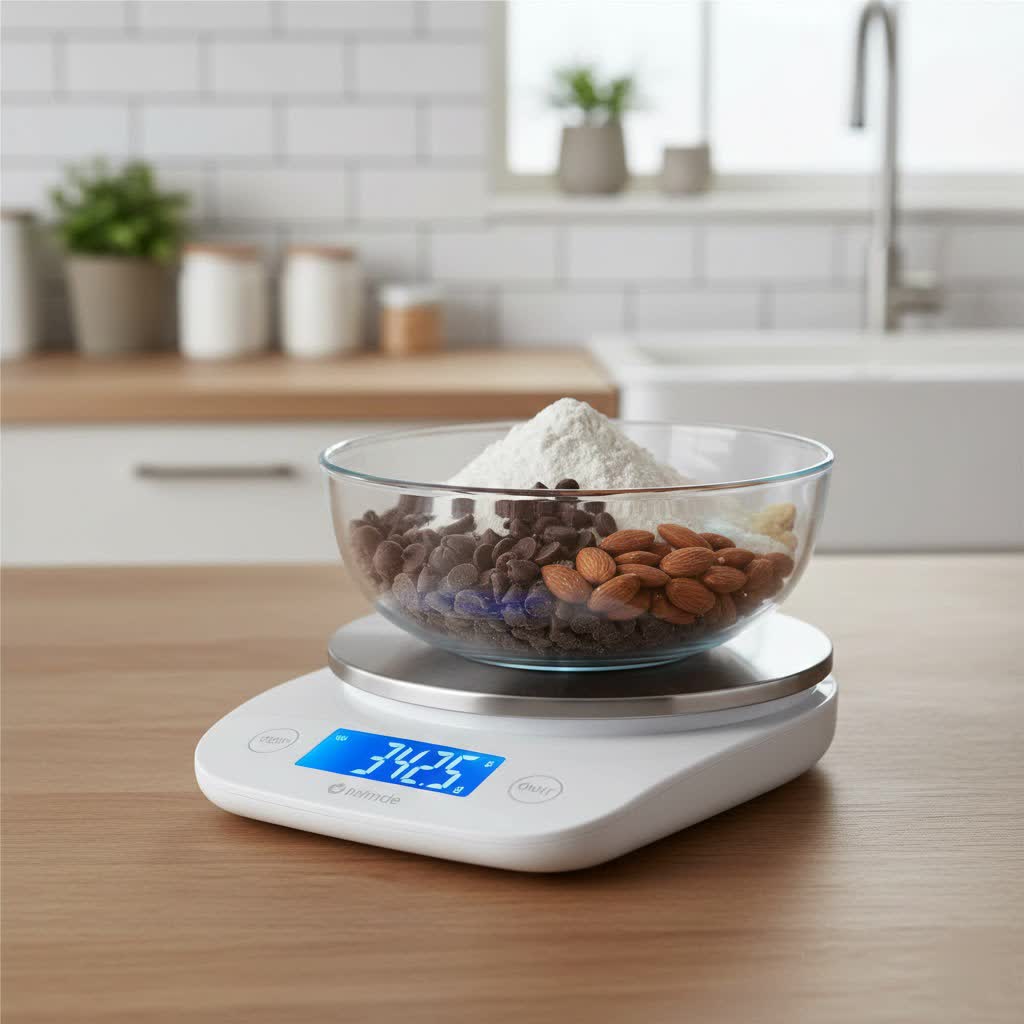
Embarking on your Baker’s Percentage journey requires a few essential tools and a shift in mindset. The most critical piece of equipment is a reliable digital kitchen scale. Look for one that measures in grams and ounces with at least 1-gram (or 0.1-ounce) increments for optimal precision. Many modern scales also feature a “tare” function to zero out the weight of your bowl and a direct percentage function, which can greatly simplify the process.
Beyond the scale, it’s vital to embrace weight measurements, predominantly grams or ounces, over volume. While many recipes still use cups and spoons, converting them to weight is paramount for Baker’s Percentage accuracy. Finally, having your recipe converted into Baker’s Percentages is a prerequisite. If your favorite recipe isn’t already in this format, you’ll need to do the initial calculation to establish the percentage for each ingredient based on its weight relative to the flour’s weight.
Step-by-Step Guide: Using Baker’s Percentage on Your Digital Scale
Using Baker’s Percentage with your digital scale might seem intimidating at first, but with a clear process, it quickly becomes intuitive. Here’s how to master it:
Step 1: Understand Your Recipe in Percentages
Table is empty.Before you touch your scale, ensure your recipe is fully translated into Baker’s Percentages. For instance, if your flour is 100%, and water is 65%, that means for every 100g of flour, you need 65g of water. Decide on your total desired flour weight first. This is your starting point for scaling. If your recipe uses 500g of flour, and you want to make a larger batch, you might decide to use 750g of flour.
Step 2: Place Your Bowl and Tare the Scale
Turn on your digital kitchen scale and place an empty mixing bowl (or the container you’ll use for ingredients) onto the weighing platform. Press the “Tare” or “Zero” button. This crucial step subtracts the weight of the bowl, ensuring that your scale only measures the ingredients you add. Always ensure the reading is exactly 0 before proceeding.
Step 3: Weigh the Flour and Set as 100%
Carefully add your flour to the tared bowl until you reach your predetermined flour weight (e.g., 500g). If your scale has a dedicated “%” function, now is the time to activate it. With the flour on the scale, press the “%” button to set this weight as your 100%. The display should now read “100%.” If your scale doesn’t have a specific percentage function, you will manually calculate the weight of each subsequent ingredient.
Step 4: Add Subsequent Ingredients by Percentage
After the flour is weighed and set as 100%, if your scale has the percentage function, you can simply add the next ingredient directly to the bowl until the display shows the target percentage for that ingredient (e.g., add water until it reads “65%”). If your scale doesn’t have this feature, you’ll need to calculate the exact weight: for 500g flour and 65% water, you’d add 325g of water (500g * 0.65 = 325g). Press “Tare” again before adding each new ingredient to measure them individually.
Step 5: Repeat for All Ingredients
Continue this process for every ingredient in your recipe. For each new ingredient, either add it until your scale’s percentage function shows the correct value, or tare the scale and add the precise calculated weight. This methodical approach ensures that all ingredients are added in their exact, proportional amounts, leading to a perfectly balanced dough or batter. Once all ingredients are measured, turn off or tare your scale to reset it.
Scaling Recipes with Baker’s Percentage: Adapt Any Formula
One of the most liberating aspects of Baker’s Percentage is its incredible flexibility for scaling recipes. Imagine you have a sourdough recipe with 500g flour (100%), 325g water (65%), 100g starter (20%), and 10g salt (2%). If you want to make a smaller loaf, perhaps using only 350g of flour, the calculation is straightforward.
You simply multiply your new desired flour weight by the decimal equivalent of each ingredient’s percentage.
- New Flour Weight: 350g (this remains 100%)
- Water: 350g * 0.65 = 227.5g
- Starter: 350g * 0.20 = 70g
- Salt: 350g * 0.02 = 7g
This method allows you to effortlessly adjust any recipe to fit your pan size, desired yield, or simply to experiment with different batch sizes without compromising the integrity of the original formula. It’s a game-changer for home bakers looking to customize their baking.
Common Pitfalls and Pro Tips for Baker’s Percentage
While Baker’s Percentage simplifies many aspects of baking, a few common pitfalls can trip up even experienced bakers. Being aware of these and adopting some pro tips will ensure your success.
First, always ensure your scale is accurate and properly calibrated. A scale that’s off by even a few grams can lead to noticeable differences, especially with sensitive ingredients like yeast or salt. Regularly check its accuracy with known weights. Second, master the tare function. Forgetting to tare before adding a new ingredient is a common mistake that throws off all subsequent measurements. Develop a habit of pressing “Tare” before each new addition.
Third, when dealing with older recipes or those not in Baker’s Percentage, convert volume to weight measurements first. A digital kitchen scale is essential for this. For example, a “cup of sugar” should be converted to its gram weight. Lastly, remember that the total sum of Baker’s Percentages will always be greater than 100%. This is not an error; it’s inherent to the system where flour is 100% and other ingredients are additions to that base. Don’t confuse it with total recipe weight percentage.
“Baker’s Percentage isn’t just a measurement system; it’s a language that allows bakers to precisely control their craft, ensuring consistency and enabling creative adaptation of any formula.”
Conclusion
Embracing Baker’s Percentage with your digital kitchen scale is one of the most significant steps you can take toward becoming a more confident and skilled baker. It elevates your baking from guesswork to scientific precision, ensuring consistent results, easy recipe scaling, and a deeper understanding of your ingredients. While it might require a slight shift in your routine, the benefits—flawless loaves, perfectly balanced cookies, and consistently delicious pastries—are immeasurable. So, grab your scale, convert your favorite recipes, and start experimenting with the power of Baker’s Percentage today. What’s the first recipe you’ll master with your newfound precision?
Frequently Asked Questions
What is the primary benefit of using Baker’s Percentage?
The primary benefit is achieving unparalleled precision and consistency in your baking. By always basing ingredient amounts on the flour’s weight (100%), you eliminate variability and ensure that your recipes turn out perfectly every time, making scaling and adjusting formulas much simpler.
Do I need a special scale to use Baker’s Percentage?
While any accurate Digital Kitchen Scale that measures in grams or ounces will work, some advanced models have a dedicated “%” button. This feature allows you to set the flour weight as 100% and then automatically display subsequent ingredients as a percentage of that flour weight, simplifying the process even further.
Can I convert any recipe to Baker’s Percentage?
Yes, theoretically, any recipe can be converted to Baker’s Percentage. The key is to first get accurate weight measurements for all ingredients, especially the flour. Once you have these weights, you can calculate each ingredient’s percentage relative to the flour’s weight using the formula (Ingredient weight / Flour weight) x 100%.
Why do Baker’s Percentages often add up to more than 100%?
Baker’s Percentage is fundamentally different from a total percentage. In this system, flour is always 100%, and all other ingredients are expressed as a percentage of that flour weight. Since you’re adding ingredients to the flour, the sum of all percentages will naturally exceed 100%, reflecting the total hydration and enrichment relative to the flour.